
Home Health Monitoring for Seniors: Which Numbers to Take, and How to Take Them Right (2026)
Home health monitoring devices for elderly parents: wrist vs upper arm blood pressure, cuff size, pulse oximeter limits, daily weight, and what to log.
ElderHearth offers general information, not medical advice. Which numbers a parent should track, how often, and what to do about a reading are decisions for their doctor; a home device does not diagnose anything. ElderHearth earns a commission on the Vive Health links below, at no cost to you; specifications come from the product pages linked where they are used.
Home health monitoring devices for elderly parents are only as good as the technique and the log. A blood pressure taken over a sleeve, after coffee, with the arm hanging, reads high and sends a parent to a doctor who then treats a number that was never real. A weight taken at a different hour in different clothes can hide the two or three pounds of fluid that signal heart failure building. This guide covers the four numbers most often taken at home, blood pressure, oxygen, weight and blood sugar, with the technique for each from the agency that publishes it, the device choice that follows from a parent's body rather than a spec sheet, and what to write down so the numbers are worth something at the next appointment.
Which numbers, and who should be taking them
Start with the doctor, not the catalog. The CDC's page on measuring blood pressure frames home monitoring as something done with a clinician rather than instead of one: "Talk with your health care team about regularly measuring your blood pressure at home. This is called self-measured blood pressure (SMBP) monitoring", and it says the evidence favors that arrangement: "Evidence shows that people with high blood pressure are more likely to lower their blood pressure if they use SMBP combined with support from their health care team than if they don't use SMBP."
The signs a parent has reached home monitoring are usually clinical rather than behavioral: a new blood pressure medication and a doctor who wants morning readings; a heart failure diagnosis, where daily weight is part of the treatment; COPD, where oxygen and symptoms track together; diabetes on insulin. The behavioral sign is the other one: an adult child in another state who cannot get a straight answer on the phone, which is the reason a shared log matters as much as the device.
Two things not to buy: a device for a number nobody asked for, and a device a parent cannot operate. A monitor with a button the arthritic hand cannot press, a display the eyes cannot read, or an app the parent will never open is a monitor that produces no data.
Blood pressure: the technique decides the number
The technique is not optional. The CDC's home checklist is specific, and every item on it moves the reading: "Don't eat or drink anything 30 minutes before you take your blood pressure. Empty your bladder before your reading. Sit in a comfortable chair with your back supported for at least 5 minutes before your reading. Put both feet flat on the ground and keep your legs uncrossed. Rest your arm with the cuff on a table at chest height. Make sure the blood pressure cuff is snug but not too tight. The cuff should be against your bare skin, not over clothing. Do not talk while your blood pressure is being measured."
Then the schedule, from the same page: "Use a blood pressure log to record your blood pressure measurements. Take your blood pressure at the same time every day. Take at least two readings, 1 or 2 minutes apart." Two readings, because the first is often the highest; the log, because a single number at an appointment tells a doctor nothing about the pattern.
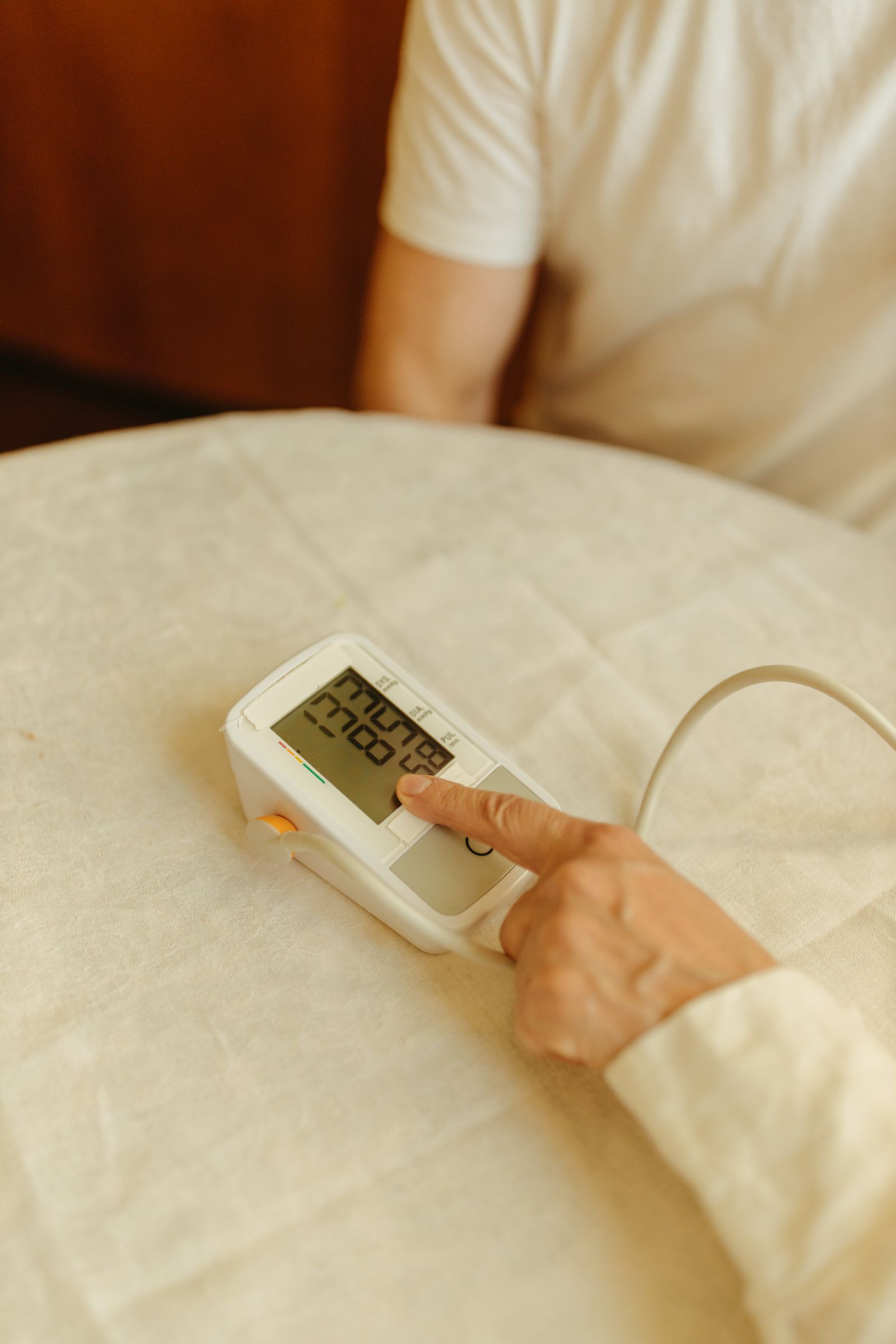
Wrist vs upper arm blood pressure monitor for seniors. An upper arm monitor is the default, because the arm is where the technique above is written for and where the cuff sits level with the heart on a table. A wrist monitor is easier for a parent who cannot reach across to fit an arm cuff one-handed, or whose arm is too large or too painful for a cuff, and it is the more forgiving device for arthritis; the cost is that the wrist has to be held at heart height for the reading to mean anything, which is one more thing to get right. Vive's upper arm monitor stores "up to 250 readings per user" for two users and has irregular heartbeat detection; its wrist monitor has a cuff sized for wrists from 4.9 to 8.3 inches and inflates automatically.
Cuff size is the specification that matters most. A cuff too small reads high, and the difference is not trivial. The Vive arm monitor's page gives its adult cuff range as 8.75 to 16.5 inches, and its replacement cuff covers 8.66 to 16.54 inches and is described as compatible with "all Vive precision monitors, Omron 10 Series monitors and IProven monitors". Measure the parent's upper arm circumference at the midpoint before ordering; an arm above that range needs a large cuff, which is a different purchase, and cuff size is one of the first things to check when home readings disagree with the clinic.
What the numbers mean, and what a high reading at home should prompt, is in our guide to high blood pressure in older adults.
Are pulse oximeters accurate for elderly parents?
A pulse oximeter clips on a finger and estimates blood oxygen. The FDA's Pulse Oximeter Basics is blunt about what an over-the-counter one is not: "These products are not evaluated by the agency for use in clinical decision-making or determining whether to seek medical intervention." And on accuracy, the same page lists what moves a reading: "multiple factors can affect the accuracy of a pulse oximeter reading, such as poor circulation, skin pigmentation, skin thickness, skin temperature, current tobacco use, and use of fingernail polish." Skin tone is its own known problem: "Current scientific evidence suggests there are some accuracy differences in pulse oximeter performance between individuals with lighter and darker skin pigmentation."
So the rule the FDA gives is to read the number alongside the person: "in addition to your pulse oximeter reading, keep track of your symptoms and how you feel", and "Pulse oximeter readings should be considered in context with other information, including signs and symptoms of low oxygen." The technique, also from the FDA: "make sure your hand is warm, relaxed, and held below the level of the heart. Remove any fingernail polish on that finger. Sit still and do not move the part of your body where the pulse oximeter is located. Wait a few seconds until the reading stops changing and displays one steady number." A cold hand is a common cause of a frightening low reading, and warming it for a few minutes is worth doing before anyone panics.
The symptoms to know alongside the number, from the FDA page, are "Bluish coloring in the face, lips, or nails. Shortness of breath, difficulty breathing, or a cough that gets worse. Restlessness and discomfort. Chest pain or tightness. Fast/racing pulse rate", with the caution that "some people with low oxygen levels may not show any or all these symptoms." For a parent with COPD, the oximeter is a tracking tool inside a plan their doctor set; our COPD in older adults guide covers the exacerbation signs that matter more than the number. Vive's pulse oximeter is a standard fingertip model at about $18.
Daily weight for heart failure: the number that catches fluid early
For a parent with heart failure, the bathroom scale is a medical device, and the method is exact. MedlinePlus's heart failure home care instructions give it: "Weigh yourself every morning on the same scale when you get up -- before you eat and after you use the bathroom. Make sure you are wearing similar clothing each time you weigh yourself. Write down your weight every day on a chart so that you can keep track of it."
Then the thresholds that turn the number into an action: "Contact your provider if your weight goes up by more than 2 to 3 pounds (1 to 1.5 kilograms, kg) in a day or 5 pounds (2 kg) in a week. Also contact your provider if you lose a lot of weight." That is fluid, not fat, and it builds days before the breathlessness does; catching it is often the difference between a medication change at home and an admission. The same page names the parallel signs: "You might also find that your clothes and shoes are feeling tighter than normal when there is too much fluid in your body."
The scale itself needs to be one thing above all: the same scale, in the same place, every day. A parent with balance problems needs a wide platform and a steady surface, not a thick bathroom rug; Vive's bathroom scale is rated to "400 pounds (180 kg)". What the weight means in the context of the rest of heart failure care is in heart disease in older adults.
Blood sugar and temperature
Blood sugar. For a parent on insulin or on medications that can cause lows, the meter is prescribed with a schedule and targets from their doctor, and that schedule is the thing to follow rather than anything on this page; our diabetes in older adults guide covers why targets for an older adult are often looser than for a younger one, and what a low looks like in someone with dementia. Vive's glucose monitoring system reports results "in just 5 seconds" and keeps "up to 500 readings" with date and time; strips are the ongoing cost and the thing to check for compatibility before buying any meter.
Temperature. A digital thermometer is the cheapest device on this page, and it matters because an older adult's infection often shows as confusion, falling or loss of appetite before it shows as a high fever. Vive's digital thermometer is about $8 and keeps the last reading for comparison. Take it the same way each time, and tell the doctor how it was taken; an oral reading and a forehead reading are not the same number.
Where to buy: Vive sells the upper arm monitor, wrist monitor, replacement cuff, pulse oximeter, bathroom scale, glucose meter and digital thermometer direct under its Vive Precision label; the return terms are in our Vive Health review.
The log is the product
A device produces a number; a log produces a decision. Three rules make a home log useful to a doctor.
Same conditions, every time. Same hour, same chair, same scale, same clothing. A reading taken under different conditions is not comparable to the one before it, which is why the CDC and MedlinePlus instructions above are so specific about the setup.
Write the context, not just the number. Date, time, the reading, and anything unusual: a missed dose, a bad night, a cold hand, a new medication. The FDA asks for exactly this with oxygen: "Write down your oxygen level and the date and time of the reading so you can track any changes and report these to your health care provider."
Bring it, or share it. A paper chart on the fridge works. So does a phone photo of it sent weekly to the child who is out of state; what does not work is a parent trying to remember at the appointment. Some Vive Precision devices pair with a phone app, which suits a family already comfortable with one; for a parent who is not, the paper chart is better data than an app nobody opens. The broader question of remote monitoring, sensors and alerting systems is in technology to monitor an aging parent.
Teaching the technique, once
Sit with the parent and do the whole sequence together three times: the five minutes of sitting, the bare arm, the table at chest height, the two readings a minute apart, the entry in the log. Then watch them do it alone once. The errors that survive that session are the ones worth solving with equipment: a cuff that is hard to fasten one-handed points to the wrist model; a display that has to be held to the light points to a bigger screen; a parent who cannot remember the sequence needs it written on a card taped inside the cabinet door, which is where the device should live so it is used at the same time each day.
What Medicare pays for
Medicare's blood sugar monitors page says "Medicare Part B (Medical Insurance) covers blood glucose (sugar) monitors that your doctor prescribes for use in your home", with the patient paying "20% of the Medicare-approved amount" after the deductible; test strips and control solutions have their own coverage pages. The general rule, from Medicare's DME coverage page, is that "Part B covers medically necessary DME if your doctor or other health care provider orders it for use in your home."
Blood pressure monitors surprise families: Medicare has no coverage page for a home blood pressure monitor alongside the ones it publishes for blood sugar monitors and strips, and a parent who wants one for daily monitoring generally buys it. At Vive's list prices on the day we read them, that is about $70 for an upper arm monitor, $40 for the wrist model and $20 for the replacement cuff. Bathroom scales, pulse oximeters and thermometers are ordinary purchases too, at roughly $25, $18 and $8. Ask the parent's doctor or a Medicare-enrolled supplier before assuming either way, and note that Vive Health does not accept Medicare, Medicaid or HSA cards, and says so in its FAQ.
Frequently Asked Questions
How do you take blood pressure at home correctly? Nothing to eat or drink for 30 minutes, bladder emptied, five minutes sitting with the back supported, feet flat and legs uncrossed, the arm resting on a table at chest height, the cuff snug on bare skin, and no talking. Take two readings one or two minutes apart, at the same time each day, and write them down. Those are the CDC's instructions, and each item changes the number.
Wrist or upper arm blood pressure monitor for an elderly parent? Upper arm is the default, since the technique guidance is written for it and the cuff rests at heart level on a table. A wrist monitor suits a parent who cannot fit an arm cuff one-handed or whose arm is too large or too sore for one, as long as they can hold the wrist at heart height. Cuff size matters more than the type: measure the upper arm before buying.
Are pulse oximeters accurate for older adults? They estimate, and the FDA lists poor circulation, skin pigmentation, skin thickness, skin temperature, tobacco use and nail polish as factors that affect accuracy, with known differences between lighter and darker skin. Over-the-counter oximeters are not evaluated by the FDA for clinical decision-making, so read the number alongside symptoms and warm a cold hand before trusting a low reading.
How much weight gain is a warning sign in heart failure? MedlinePlus's instructions say to contact the provider for a gain of more than 2 to 3 pounds in a day or 5 pounds in a week, weighing every morning on the same scale after the bathroom and before eating, in similar clothing. That weight is fluid, and it usually appears before the breathlessness does.
Does Medicare pay for a home blood pressure monitor? Medicare publishes coverage pages for blood sugar monitors and test strips but not for a home blood pressure monitor, so most families buy one themselves. Glucose monitors a doctor prescribes for home use are covered under Part B with 20 percent coinsurance after the deductible. Ask the doctor or a Medicare-enrolled supplier about a particular device before buying.
The number is only half of it
Buy the device the doctor asked for, size the cuff to the arm, teach the sequence once with the parent doing it themselves, and put a chart where the device lives. The numbers then belong to the next appointment rather than to the drawer. What each number means is in the condition guides, high blood pressure, heart disease, diabetes and COPD; the equipment for the rest of the house is in the aging-in-place plan. If you would like someone to read what you are dealing with before you order, write to us.
Sources
- Centers for Disease Control and Prevention, Measure Your Blood Pressure (home measurement checklist, two readings, logging, SMBP evidence).
- U.S. Food and Drug Administration, Pulse Oximeter Basics (accuracy factors, skin pigmentation, over-the-counter limitation, technique, symptoms).
- MedlinePlus, National Library of Medicine, Heart failure: home monitoring (daily weight method and thresholds).
- Vive Health, product pages for the upper arm blood pressure monitor, wrist blood pressure monitor, replacement cuff, pulse oximeter, bathroom scale, blood glucose monitoring system and digital thermometer (specifications as published on September 21, 2026), and its FAQ (payment methods).
- Medicare.gov, Durable medical equipment (DME) coverage.