
Home Exercise Equipment for Seniors: Bands, Balance Pads and the Days Between Therapy Visits (2026)
Home exercise equipment for elderly parents: balance pads, resistance bands, pedal exercisers, TENS limits, and the home program between therapy visits.
ElderHearth offers general information, not medical advice. What a parent should do, how hard, and when to stop is the treating clinician's call, and equipment bought without that plan is a guess with a receipt. ElderHearth earns a commission on the Vive Health links below, at no cost to you; specifications come from the product pages linked where they are used.
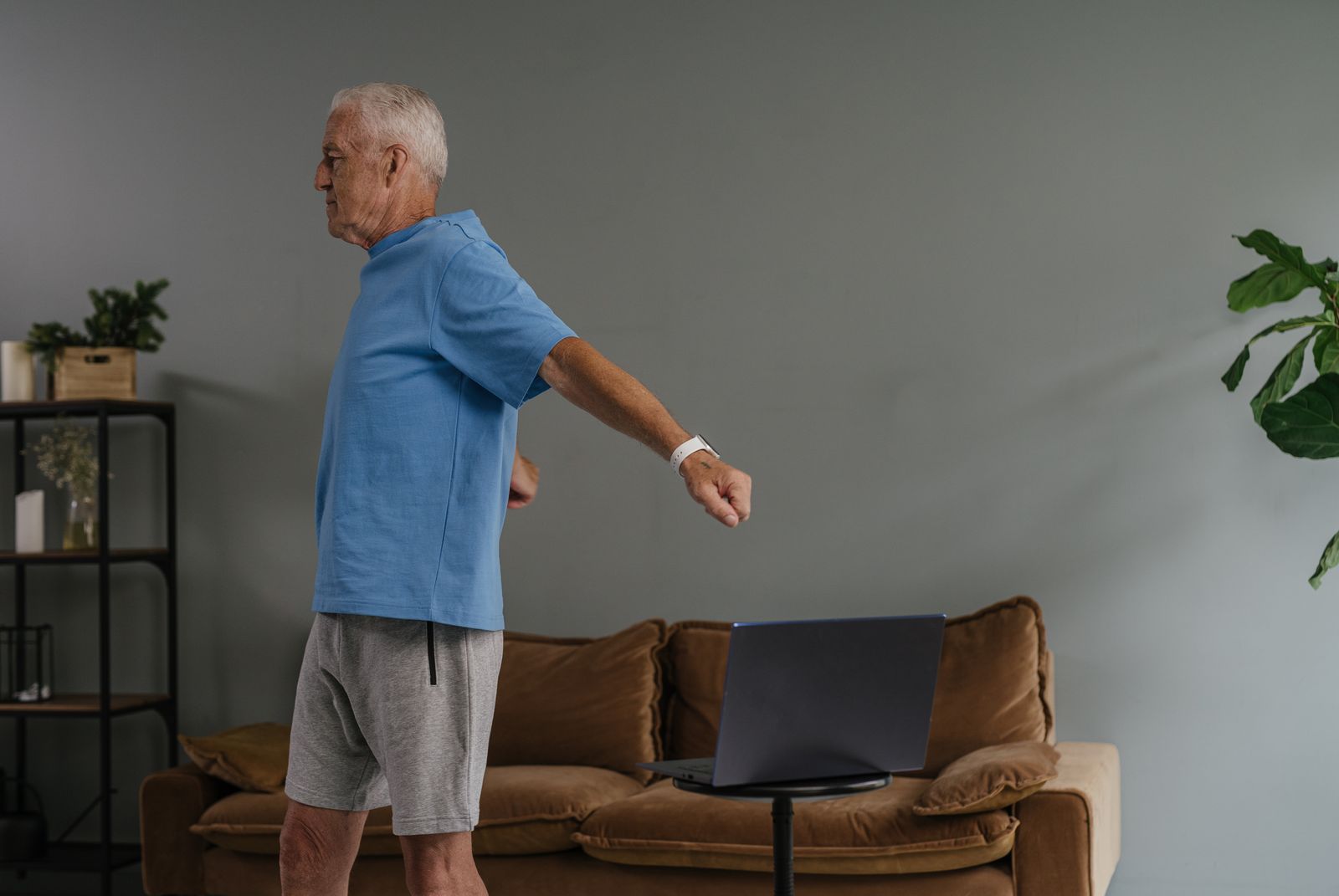
The therapist's car pulls out of the driveway, and the rest of the week belongs to the sheet of exercises on the refrigerator. Medicare's home health page describes those visits as "part-time or intermittent", which leaves the days in between to home exercise equipment for elderly parents: a chair, a band, a balance pad, twenty minutes on the days nobody comes. This page covers what the guidelines ask an older adult to do each week, the equipment that maps onto each of those jobs, balance, strength, endurance and stretching, what a home program should look like in its first month, and the one item here, a TENS unit, with hard limits rather than comfortable ones. The exercises themselves are in our guide to fall prevention exercises for seniors.
What the guidelines ask for, and what the equipment is for
The target is not complicated. The CDC's older adult activity page lists it in three lines: "At least 150 minutes at moderate intensity. This could be 30 minutes a day, 5 days a week", "At least 2 days of activities that strengthen muscles", and "Activities to improve balance". The National Institute on Aging puts the same work in one sentence on its infographic page: "Research has shown that it's important to get all three types of exercise: aerobic, muscle-strengthening, and balance."
Two of those three are the ones families let slide, and the reason each matters is stated plainly on the same NIA page: "Muscle-strengthening exercises can help you stay independent and prevent fall-related injuries", and "Balance exercises help prevent falls and can improve stability."
Equipment does not replace any of that. It does one job: it makes a specific piece of the program possible at home, on a Tuesday, for a parent who will not be going to a gym or a class. Each of the jobs below gets the cheap version first, because for most parents the cheap version is the one that gets used.
The signals, by what changes in the house
- The therapist's sheet stopped being followed by the second week, and nobody has said so out loud.
- Standing up from the dining chair now takes two tries, or a push off the table.
- The walk to the mailbox got shorter after the last hospital stay, and it never went back.
- An afternoon passes without the parent standing up between programs.
- The parent says the exercises are for the leg, as if they were a treatment rather than part of the day.
- Underneath those: the fear of falling again, and the worry about doing it wrong while nobody is watching.
The numbers behind the fear are worth knowing. CDC's STEADI program puts it like this: "Every year more than one in four older adults reported falling and about 43,000 older adults die as a result of a fall, that's 117 older adults every day." The days between therapist visits are the days that number is built on.
Balance: the pad, the disc, and the chair that is already there
A new unsteadiness, dizziness on standing, or a balance problem that appeared over weeks is a doctor's appointment before it is a balance pad. The free version comes first. The CDC's activity page describes balance work as "PLUS Balance activities such as walking heel-to-toe or standing from a sitting position", which is a hallway and a dining chair. The balance exercises for seniors at home that hold up are mostly this plain, and a parent who can do them consistently is already meeting the guideline.
A balance pad adds the part a chair cannot: an unstable surface, which is what makes the ankle and the hip do the correcting. Vive's balance pad is described as "Providing a moderately unstable surface" that "improves overall balance, increasing core strength, joint stability and mobility", and its inflatable disc is the cheaper, smaller version of the same idea, a "Latex-free and tear-resistant" cushion that "supports up to 440 pounds".
How to use either one, practically:
- Set it beside a counter or the back of a sturdy chair, so both hands have somewhere to go the first week.
- Start with standing on it, feet apart, holding on, for a minute; then one hand; then no hands, still next to the counter.
- Progress by time and by stance before adding any movement on the pad.
- Keep the walking practice. A pad trains the correction; it does not replace the walk.
If standing on an unstable surface is not safe yet, the seated version is the disc under the hips for posture and core work, not a balance exercise, and the honest answer is that the chair rise is doing more for the parent than the disc is.
Strength: resistance bands for elderly parents, in two shapes
Bands are the strength equipment that survives a small house: they hang on a hook, they weigh nothing, and the resistance is chosen by color rather than by a rack of iron.
Loops are the small flat rings used for the hips and thighs, and they are the cheapest useful purchase on this page. Vive's loop bands come in a set that "Effectively stretches, strengthens and tones muscles for greater stability and flexibility", and the page answers the question families ask about safety with a number worth keeping: "The Vive loop bands can safely stretch to twice their original length."
Tube bands with handles are for the pulling movements, rows, presses and arm work, seated or standing. Vive's tube set puts it as "five resistances levels that can be combined in a variety of ways for effective, progressive workouts", and the box is complete enough to start: "Includes five tube resistance bands, two handles, two ankle straps, one door anchor and a convenient storage bag."
The door anchor is the one part to think about. Anchor it as the included guide shows, pull-test it before every session, and route the band at chest height rather than at the face or neck; a band that slips off an anchor snaps back faster than anyone expects. The rule for progression is the color, not the number of reps: when a set is easy, the next color up, or one more set, and never both in the same week.
The hands get their own two tools, and for a parent who cannot grip a jar, they are the ones that show up first in a day. Therapy putty is squeezed, pinched and rolled, which the page describes as working "coordination of fine motor skills", and it comes in graded firmness for "progressive therapy and strengthening". Hand exercisers add resistance for the fingers and the wrist with "Three color-coded tension levels safely build strength and flexibility."
A hand that has lost strength over weeks, drops things, or goes numb is a doctor's question before it is a putty question; the joint and nerve side of that is in arthritis in older adults.
Endurance from a chair: the pedal exerciser
Walking is the usual endurance answer, and it is also the first thing a parent gives up when the knees hurt or the fear of falling is fresh. For a parent who cannot walk far, a pedal exerciser for seniors is the endurance option that does not ask for balance: the parent sits, the feet turn the pedals, and the heart and lungs get the same moderate-intensity work the guideline asks for.
Vive's pedal exerciser "Works for both arms and legs to build strength and improve stamina", with the intensity set by "the turn of a knob", and its published weight limit is worth checking against the chair it will be used from: "The weight limit is 220 pounds." The folding under-desk model is lighter and cheaper, "fits beneath most desks at just 9 inches tall", and "weighs under 7 pounds, folds flat for storage".
Three things decide whether it gets used:
- Tension low enough to talk through. The CDC's activity page has the line that settles most family arguments about effort: "Remember that some physical activity is better than none at all", and for a parent who cannot reach the target, "be as physically active as your abilities and conditions allow."
- A chair with arms, so getting on and off the pedals is not a balance test.
- A time that is already in the day, during a program the parent watches, or after the morning coffee, because a machine that has to be remembered is a machine that stops.
Start at five minutes with almost no tension and add time before adding resistance. The rest of the endurance target can come from walking, and for a parent with a walking program already, the pedals are what happens on the days the weather or the knees say no.
Stretch and reach: strap and pulley
Stretching is the part of the program that keeps the shoulder and the hamstring usable, and it is the hardest to do alone, because the hands cannot reach the foot or the arm cannot get overhead.
A stretch strap is the low-tech fix for the legs: the strap extends the arm's reach to the foot, and the page notes that "The extra long nylon strap allows people of all sizes and ability to use" it and that "10 loops accommodate most types of shoes and can be used as handholds for multiple exercises."
A shoulder pulley is the same idea for the shoulder, a rope over a door bracket with the good arm doing the pulling. The graduation marks are the reason to prefer a pulley with them: "Graduated markings are spaced six inches apart to allow users to limit range of motion or easily track progression during rehabilitation." The rope is long enough to use sitting down, which matters for a parent in a wheelchair or a chair by the door frame.
Two rules. Stretch a joint that is warm, at the end of a session or after a shower, not first thing on a cold morning. And after a joint replacement or a rotator cuff repair, the ranges are the surgeon's and the therapist's to set; the strap is the tool that carries out the protocol, not a way around it, and the same is true of the whole recovery timeline covered in hip fracture recovery in the elderly.
TENS: what it helps, and who must not use one
A TENS unit sends a mild current through adhesive pads to interrupt pain signaling. It is the one product on this page sold without a prescription that has real limits attached to it, and they are written down by the agency that clears the devices.
What the device claims is modest, in Vive's own description: it will "Ease tired muscles and enjoy therapeutic pain relief all over your body including your shoulders, back, legs, knee, feet and arms", with "The included rechargeable lithium battery can be used up to 10 hours per charge."
The labeling FDA cleared for the AWQ-104, one TENS unit, carries the boundaries families skip. The sources section names that 510(k); it is not a rule written for every unit on the market. From the cleared labeling (PDF): "Stimulation will inhibit the output of some demand cardiac pacemakers and therefore, is not recommended for patients with this type of pacemaker", and "Severe spasm of the laryngeal and pharyngeal muscles may occur when an electrode is placed across the neck or mouth", enough to close off the airway. The same document states the device "cannot be used transcerebrally, in the carotid sinus area or during pregnancy."
For TENS devices cleared to treat headache, the labeling rule itself, 21 CFR 882.5891, requires "contraindications such as not for use in subjects with an implanted metallic or electronic device in the head, a cardiac pacemaker, or an implanted or wearable defibrillator" and "warnings such as not to apply the device on the neck or chest, not to use the device in the presence of electronic monitoring equipment, not to use in the bath or shower, not to use while sleeping, not to use while driving, not to use while operating machinery."
The scope of that rule is one device type, and the cautions are the ones to hold to in a house anyway: pads off the neck, the chest and the head; no session in the bath; none while asleep or behind the wheel; and for a parent with a pacemaker, an implanted defibrillator or another implanted electronic device, a conversation with the cardiologist who manages it before anything is ordered.
One more line from the cleared labeling: "Electrical nerve stimulation is a symptomatic treatment, and as such may suppress the progress of pain which would otherwise serve as a protective influence on the outcome of a disease process." In a house with a healing fracture or a new hip, pain is information. A unit that mutes it can hide the thing the surgeon needs to see, which places TENS after the diagnosis and the explanation, never before them.
Cold and massage, and where they stop
The cold machine is the post-surgical piece. Vive's cold therapy machine circulates chilled water through a pad, and the published numbers are what make it different from a bag of peas: "The 6-liter tank on this post surgery ice machine holds enough ice and water for 30 to 60 minute sessions", with "Digital controls on our ice treatment machine let you pick flow rate and session length in 5-minute steps." It is the item on the page to price after talking to the surgeon or the discharge planner rather than before, and at $249.99 it is also the largest purchase here.
For the muscles around a healing joint, a massage cane puts the reach back in the parent's own hands: "Five smooth nodes and three pointed spikes across eight knobs mean you can go gentle on surface tension or dig into deeper soreness." It is for muscle, not for joints, and not for swelling.
One boundary belongs on the wall next to it. A calf that is newly swollen, warm and painful is not a massage problem. MedlinePlus's deep vein thrombosis page lists warmth and tenderness over the vein, pain or swelling in the affected part, and skin redness as the symptoms, and notes that "Sitting still for a long time can make you more likely to get a DVT." That combination is a same-day call to a doctor, not a session with a roller.
Running the home program, and getting a parent to do it
The sheet the therapist leaves is the plan; everything above is the delivery. Four things make the delivery work, and the first one is the pace. From the National Institute on Aging's tips page: "It's important to increase your amount of physical activity gradually over a period of weeks to months", and more specifically, "To reduce the risk of injury, start with lower-intensity activities that are appropriate for your current fitness level. Then increase the frequency, intensity, and duration of activities over time."
The warm-up is the second. The same page is blunt about why it matters at this age: "Warming up before exercise and cooling down after exercise is recommended to help prevent injuries and other negative health events, such as heart attack or stroke", because "A warm-up prepares the muscles for exercise and allows the heart rate and breathing to increase gradually." In practice that is two minutes of marching in the chair and slow arm circles before the bands come out, and the same again at the end.
The third is the stop rule, built from the same reasoning: chest pain, dizziness, or a new pain that does not settle is a call to the doctor, not another set. A parent who has been told to stop by their body has not failed the program.
The fourth is the one families underrate, because it is not about the equipment. The NIA's list of why older adults do not exercise is mostly not about laziness: "Some people don't know about or have access to safe places to be active, facilities or equipment can be costly, and some people may have concerns about their ability, getting injured, or falling." Every one of those is answered by making the equipment cheap, close, and familiar: it lives in the chair the parent already uses, the session is ten minutes rather than an hour, the therapist's sheet is taped where the equipment sits, and the first week is done together.
Two more lines from that page are worth having ready when motivation lags. "Working your way up slowly and steadily can also help to build confidence, motivation, and a regular routine", and after an illness or a trip, "When there is a break in your routine, perhaps due to illness or travel, work back up gradually." Progress a parent can see, a band that is now the next color, a chair rise that takes one try, is worth more than any explanation of why it matters.
When it is not an exercise problem
Balance is the one thing on this page that has a medical question underneath it, and MedlinePlus is direct about the order of operations. "Balance problems can make you feel unsteady", and "It is important to see your doctor about balance problems. They can be a sign of other health problems, such as an ear infection or a stroke."
That does not make exercise the wrong answer; it makes it the second answer. The same page notes that "Exercises, a change in diet, and some medicines also can help", and the reason it belongs after the evaluation is one line from earlier on it: "They are one cause of falls and fall-related injuries, such as a hip fracture (broken hip)." A new unsteadiness, dizziness on standing, or a balance problem that appeared over weeks is a doctor's appointment before it is a balance pad.
Two more patterns that are not equipment problems: a joint that is hot, red or newly swollen, and dizziness that comes on when standing up, which CDC's STEADI materials address in a brochure on postural hypotension. Both belong to the parent's clinician, and both make a session that day a bad idea.
What Medicare pays for
Therapy is covered, and the equipment usually is not. Medicare's physical therapy page states that "Medicare Part B (Medical Insurance) helps pay for medically necessary outpatient physical therapy, if you're eligible", with the patient paying "20% of the Medicare-approved amount" after the Part B deductible, and it also sets who has to sign off: "Your doctor or other health care provider (including a nurse practitioner, clinical nurse specialist, or physician assistant) must certify that you need it." On the limit families remember from the old therapy caps, the same page is clear: "There's no limit on how much Medicare pays for your medically necessary outpatient therapy services in one calendar year."
When the parent cannot get out, the therapy comes to the house under a different benefit. Medicare's home health page lists "Physical therapy, occupational therapy, and speech-language pathology services (if you meet certain conditions)" among what home health covers, with a gate in front of it: "a doctor or health care provider (like a nurse practitioner) must see you in person and confirm you need home health care. They must also order your care, and a Medicare-certified home health agency must provide it."
The equipment itself sits outside those benefits, which is why this page prices things at all. Medicare's DME page defines covered equipment as durable, used for a medical reason, "Typically only useful to someone who is sick or injured", used in the home, and lasting at least three years, and a band or a balance pad does not read that way. Expect them to be cash purchases: at Vive's list prices as read on September 25, 2026, about $13 for the loop bands, $18 for the disc, $20 for the putty, $39 for the balance pad, $45 for the folding pedal exerciser, $50 for the TENS unit, and $250 for the cold machine. Vive Health does not accept Medicare, Medicaid or HSA cards, and says so in its FAQ.
Where to buy: Vive sells the balance pad, balance disc, loop bands, tube band set, hand therapy putty, hand exercisers, pedal exerciser, folding pedal exerciser, stretch strap, shoulder pulley, massage cane, TENS unit and cold therapy machine direct; the return terms, including which opened items Vive will not take back, are in our Vive Health review.
Frequently Asked Questions
Is home exercise equipment for elderly parents safe to start without a therapist? For a plain walking, band and chair program, yes, with two exceptions: after surgery or a fracture, and when balance has changed, both of which need a clinician first. Get the program before the equipment, even if it is one visit to a physical therapist who writes the sheet, and buy only what the sheet calls for. Start at the lowest intensity and the shortest time, warm up first, and add time before resistance. Stop for chest pain, dizziness, or a new pain that does not settle, and call the doctor about it rather than pushing through.
What does a physical therapist usually send home? Bands or a strap for the specific joint, and a sheet of exercises sized to the parent's chair and hallway. The equipment is chosen to match the exercise, so the sheet comes first and the shopping list follows from it.
Is a pedal exerciser good for an elderly parent? It is the endurance option that works from a seated position, which suits a parent who cannot walk far or has balance trouble, and both Vive's models are built for low-impact use. Check the weight limit against the chair, keep the tension low enough to talk through, and start with five minutes. It supplements walking rather than replacing it, and it does nothing for balance or strength on its own.
Is a TENS unit safe for an elderly parent? Not for everyone. The labeling FDA cleared for the AWQ-104 states that stimulation will inhibit the output of some demand cardiac pacemakers, and FDA's labeling rule for TENS devices cleared to treat headache lists a pacemaker or another implanted electronic device as a contraindication, along with warnings against use on the neck or chest, in the bath, while sleeping or while driving. A parent with a pacemaker or another implanted electronic device should not use one without the cardiologist's agreement, and anyone with new or unexplained pain should have it diagnosed before it is muted. Used as labeled, for muscles rather than for joints that are hot or swollen, it is a low-risk tool.
Does Medicare pay for home exercise equipment? It pays for the therapy, not for the band. Medically necessary physical therapy is covered under Part B with 20 percent coinsurance after the deductible and no annual limit, and home health therapy is covered when a provider sees the parent in person, confirms the need, orders the care, and a Medicare-certified agency provides it. The equipment is a cash purchase, for the reasons on the DME page, and Vive does not accept Medicare, Medicaid or HSA cards.
The plan is the therapy
Nothing on this page treats anything. A band, a pad and a set of pedals carry out a plan a clinician wrote, on the days nobody comes, and that is where a home program is kept or dropped. Home exercise equipment for elderly parents is the cheap half of the arrangement; showing up to it is the half that takes the family, which is why the therapist's sheet matters more than the shopping list. The rest of the house is in the aging-in-place plan, the exercises themselves are in fall prevention exercises for seniors, and the first month after a fracture or a joint replacement has its own timeline in hip fracture recovery in the elderly. If you would like someone to read what you are dealing with before you order, write to us.
Sources
- Centers for Disease Control and Prevention, Older Adult Activity: An Overview (weekly recommendations, balance examples, effort guidance) and STEADI: Older Adult Fall Prevention, patient resources (fall statistics, chair rise and postural hypotension brochures).
- National Institute on Aging, Three Types of Exercise and Physical Activity (the three types and what each is for) and Tips for Getting and Staying Active (gradual progression, warm-up and cool-down, barriers to activity).
- MedlinePlus, National Library of Medicine, Balance Problems (when it is a medical problem, falls and fractures) and Deep Vein Thrombosis (symptoms, risk of sitting still).
- U.S. Food and Drug Administration, 510(k) summary for the AWQ-104 transcutaneous electrical nerve stimulator (PDF; pacemaker interference, electrode placement, symptomatic-treatment caution), and the labeling rule for TENS devices to treat headache at 21 CFR 882.5891 (contraindications and warnings).
- Medicare.gov, Physical therapy services, Home health services and Durable medical equipment (DME) coverage (coverage conditions, 20 percent coinsurance after the Part B deductible, no annual limit on outpatient therapy, and the DME definition, as verified on September 25, 2026).
- Vive Health, product pages for the balance pad, inflatable disc, loop bands, tube set, therapy putty, hand exercisers, pedal exerciser, folding pedal exerciser, stretch strap, shoulder pulley, massage cane, TENS unit and cold therapy machine (specifications and prices as published on September 25, 2026), and its FAQ (payment methods).