
Walking Aids for Seniors: Cane, Walker or Rollator, and How to Use Each (2026)
Walking aids for elderly parents: the signs it is time, cane vs walker vs rollator vs upright walker, how to fit and use each one, and what Medicare pays.
ElderHearth offers general information, not medical advice. Which aid a parent should use, and how it should be fitted, is a decision for their doctor or physical therapist; this guide is for the conversation before that visit and the practice after it. ElderHearth earns a commission on the Vive Health links below, at no cost to you; product specifications come from the pages linked where they are used, and the fitting and walking instructions from MedlinePlus, the National Library of Medicine's patient encyclopedia.
Walking aids for elderly parents come in a ladder of five rungs, cane, quad cane, walker, rollator, transport chair, and the common mistake is not picking the wrong rung; it is picking any rung a year late, after the parent has already started walking along the furniture. This guide is about the year before that: the signs that say it is time, which rung matches which kind of unsteadiness, how to fit and use each one so that it helps rather than trips, and how to raise it with a parent who thinks a cane is for other people.
The signs, in the parent's words and in their habits
A parent will rarely say they need help walking. The signs come out sideways.
What they say:
- "I'm fine, I just got up too fast." The wobble in the first few steps after standing, explained away every time.
- "My legs get tired." Standing at the stove, in a checkout line, at a graveside, and needing to lean on something by the end.
- "The floor's uneven in here." It is not; the feet are landing differently than they used to.
What they feel and mostly do not say: the fear of going down, which is the fear that shrinks a life fastest; and the belief that a cane says old in a way a bad knee does not.
What they do:
- Hand over hand along the furniture from the sofa to the kitchen. Therapists have a name for it, furniture walking, and it is the clearest sign of the four.
- Skipping the glass of water at night rather than crossing the dark hall to get it.
- Going out only as far as the mailbox, or only with someone's arm.
- A first fall, or a near fall, that was "nothing".
Any two of those together are the moment to bring it up, and the moment to book the physical therapy assessment that decides which rung. Our guide to fall prevention for seniors covers the rest of what that assessment looks at.
The five rungs, and who each one is for
The rungs are ordered by how much of the parent's weight the aid can take and how much balance it lends. MedlinePlus, in its patient instructions on using a cane, puts the first choice this way: a cane "may be a good choice if you only need a little help with balance and stability, or if your leg is only a little weak or painful", and "Talk to your health care provider or therapist if you are having a lot of pain, weakness, or balance problems. Crutches or a walker may be better options for you."
A single-point cane is for a parent with one weaker or painful side and otherwise sound balance: a bad hip, a knee waiting for surgery, a recovering ankle. It takes a little weight and lends a little balance. Vive's offset cane is the standard shape, with the handle set over the shaft so the parent's weight lands on the tip.
A quad cane is a single cane with a four-footed base, for a parent whose balance is the problem more than the leg, or who needs the cane to stand on its own when they let go of it to open a door. Vive's quad cane adjusts from 28 to 37 inches in height, supports "up to 250 pounds", and has a base that "easily adjusts for left or right-handed use". The trade is speed: all four feet have to land before it takes weight, which makes a quad cane slower than a single one.
A walker is for a parent who needs both hands on something, all the time: weakness on both sides, poor balance, the weeks after a hip or knee replacement. MedlinePlus's instructions on using a walker describe the range: "Walkers may have no wheels, 2 wheels, or 4 wheels. You can also get a walker with brakes, a carrying basket, and a sitting bench." A standard two-wheel walker like Vive's folding walker, which weighs "less than 6 pounds" and "Supports up to 250lbs", is the hospital-discharge shape: light, foldable, and it stops the moment the parent stops.
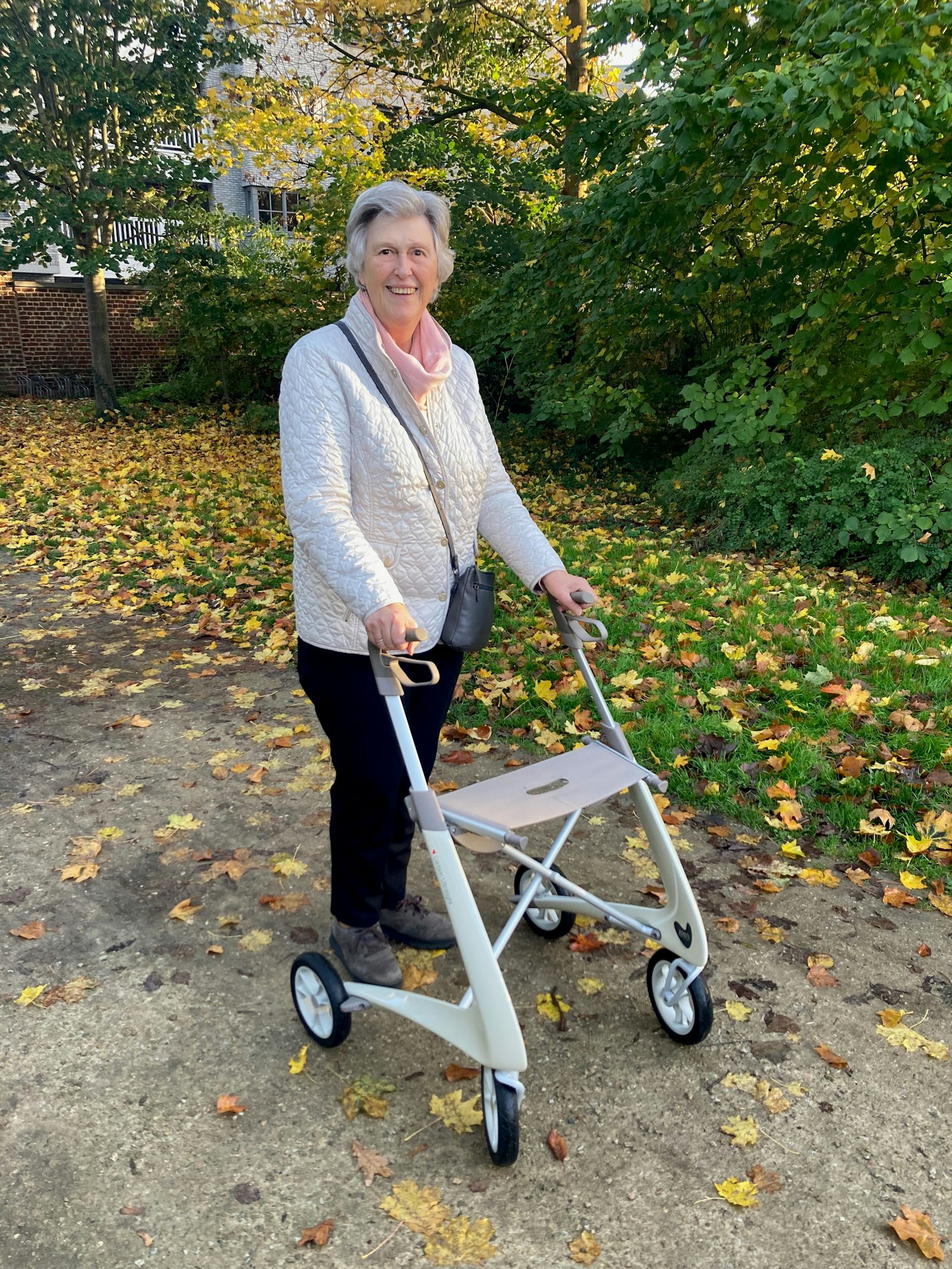
A rollator is a walker with four wheels, hand brakes and a seat, for a parent who is steady enough to control a rolling frame and who walks far enough to need somewhere to sit. The lightweight rollator from Vive weighs "only 14 lbs while remaining sturdy enough to assist users up to 300 pounds", with handles adjustable "31 to 36 inch" and a seat at 21 inches. The upright kind puts the forearms on padded rests instead of the hands on grips: Vive's upright walker adjusts "from 41 to 46 inches" to fit users from 5 feet 2 to 6 feet 4, weighs 20 pounds and supports 300, and the point of it is posture, since a parent who hunches over a standard rollator ends up looking at the floor. Which rollator suits which parent is the subject of our best rollators for seniors guide; this page is about the rung, not the model.
A transport chair is the rung for distance, not for walking: a parent who manages the house on a walker but cannot cover a hospital corridor, an airport or a mall. It is pushed by someone else, which is the difference from a wheelchair. Vive's transport wheelchair folds flat, "supports up to 300 pounds", and has 12-inch rear wheels and a seat belt. A transport chair in the trunk is often what keeps a walker-user going to places, and it is not a step backward to own both.
One rung that is not on the ladder for everyday walking: the knee walker. Vive's knee walker is "Built to support up to 300 pounds" and rolls on 8-inch wheels, but it is a recovery device for a foot or ankle that cannot bear weight, ridden by kneeling on one leg and pushing with the other. That takes balance and a strong standing leg, and a physical therapist should say whether a parent has both before one is ordered.
Where to buy: Vive sells the offset cane, the quad cane, the folding walker, the lightweight rollator, the upright walker and the transport chair direct, with free standard shipping over its threshold and a return window that requires an authorization number first; details are in our Vive Health review.
Fitting: the two measurements that make an aid safe
An aid at the wrong height is worse than no aid, because it pulls the parent's posture sideways or forward. The fitting rules from MedlinePlus are short enough to check in the living room.
For a cane, from the same instructions: "The handle should be at the level of your wrist. Your elbow should be slightly bent when you hold the handle." Have the parent stand in their usual shoes with arms hanging naturally; the handle should meet the crease of the wrist. Then the hand, which MedlinePlus calls the most common question about a cane: "The answer is the hand opposite the leg that you had surgery on, or that is the weakest." The instinct is to hold the cane on the bad side, which is the wrong side, and correcting that alone changes how the cane works.
For a walker or rollator, from the walker instructions: "The handles should be at the level of your hips. Your elbows should be slightly bent when you hold the handles." A walker set too high lifts the shoulders; set too low, it bends the parent forward over it, which is the hunch the upright design exists to prevent. The Vive folding walker adjusts in one-inch increments over a range its page gives as 5 feet 1 to 6 feet 6; the rollator handles run 31 to 36 inches. Measure the parent's hip height in shoes before ordering, and check it against the range.
Two habits from the same pages that belong with every rung. "Look forward when you walk, not down at your feet." And for any aid with more than one foot: "All 4 tips or wheels on your walker need to be on the ground before you put your weight on it."
The first week: how to use a cane and a walker
Walking with an aid is a sequence, and the sequence is the same whether the parent is 60 or 90. These are MedlinePlus's steps, and they are worth practicing in a hallway before the first trip out.
Cane, walking. From the cane page: "At the same time that you step forward with your weaker leg, swing the cane the same distance in front of you. The tip of the cane and your forward foot should be even." Then "Step past the cane with your strong leg." Turning: "Turn by pivoting on your strong leg, not the weaker leg."
Cane, curbs and stairs. The rule to say out loud until it sticks, from the same page, is "up with the good, down with the bad." Up a curb: "Step up with your stronger leg first", then bring the cane and weaker leg up to meet it. Down a curb: "Set your cane down below the step. Bring your weaker leg down." On a staircase with a rail: "If there is a handrail, hold onto it and use your cane in the other hand."
Walker, walking. From the walker page: "Push or lift your walker a few inches, or a few centimeters, or an arm's length in front of you." Then "Step forward with your weak leg first", then the other leg, "placing it in front of the weaker leg." An arm's length is the limit; a walker pushed far ahead pulls the parent into a lean.
Walker, standing up and sitting down. This is where walkers cause falls, because the instinct is to pull on the frame. MedlinePlus's instruction is the opposite: "Lean slightly forward and use your arms to help you stand up. Do not pull on or tilt the walker to help you stand up." Push up from the chair's armrests, then take the walker's handles. Sitting: "Back up to your chair, bed, or toilet until the seat touches the back of your legs", then "Reach back with one hand and grab the armrest, bed, or toilet behind you." For a rollator, add one step before either: lock both brakes.
Rollator, the brakes. The hand brakes on a rollator have two positions, squeezed to slow and pushed down to lock, and the lock is the one that matters. A rollator that rolls away while the parent sits on its seat is the accident the brakes exist to prevent, so the first week's practice is: stop, lock, turn, sit; stand, grip, unlock, go.
Raising it with a parent who says no
The refusal is about what the cane says, and the answer is to change what it says. Our guide to convincing an elderly parent to use a walker is the long version; three things from it carry over to every rung.
Start with the smallest rung that helps, because a cane is easier to say yes to than a walker. Let the parent choose the object: Vive's canes come in folding, carbon fiber, wooden and carved wooden versions, and a walking stick a parent picked is a different thing from a cane they were handed. And tie it to a place rather than a condition: "for the walk to the mailbox", "for the farmers' market", not "because you're unsteady". A cane that lives by the front door and goes on one specific outing becomes a habit; a cane bought for the house sits in the umbrella stand.
When to move up a rung, and when to move down
Up: a cane user who has started leaning hard on the cane, or holding a wall with the other hand, is a walker user who has not admitted it yet; a walker user who is exhausted by the length of a grocery store is a rollator or transport chair user for that trip. The signs are the same ones from the top of this page, appearing again with the current aid in hand.
Down: after a hip or knee replacement, the sequence often runs the other way, walker for the first weeks, then a cane, then nothing, on the therapist's schedule. A parent who came home from surgery with a walker and is still using it a year later has usually not been reassessed, and reassessment is a phone call.
What Medicare pays for
Medicare treats canes, walkers and rollators as durable medical equipment. Medicare's walkers coverage page says "Medicare Part B (Medical Insurance) covers walkers, including rollators if you're eligible", and that after the deductible "you pay 20% of the Medicare-approved amount"; its canes page says the same of canes, with one exclusion, "white canes for the blind". The equipment has to be ordered by a doctor for use in the home and come from a supplier enrolled in Medicare; the prescription, the supplier rules and what a walker costs after the 20 percent are in our guide to does Medicare cover a walker?. A transport chair is a different category, and whether a given one is covered is a question for the enrolled supplier; does Medicare cover a wheelchair? has the rules for manual chairs.
In practice, many families buy the cane or rollator outright rather than wait for the paperwork, because the prices on this page run from about $36 for a cane to $200 for an upright walker and the Medicare route requires a doctor's order and an enrolled supplier for a $36 item. Vive Health does not accept Medicare, Medicaid or HSA cards, and says so in its FAQ. The Medicare route is worth the effort for a rollator or a transport chair, and for any parent for whom $150 is a real sum.
Frequently Asked Questions
When should an elderly person use a cane? When one leg is weaker or painful and balance is otherwise sound: a bad hip, a knee waiting for surgery, a recovering ankle. MedlinePlus describes a cane as the choice for someone who needs only a little help with balance or has a leg that is only a little weak; a parent with a lot of pain, weakness or balance trouble is better served by a walker, and a therapist should make that call.
How do you measure a cane for an elderly person? Have them stand in their usual shoes with arms hanging naturally. The handle should be at the level of the wrist, and the elbow slightly bent when they hold it. The cane goes in the hand opposite the weaker leg, not the same side.
Walker vs rollator for an elderly parent: which is safer? A walker without wheels, or with two, stops when the parent stops and takes more of their weight, which makes it the safer choice for poor balance or weakness on both sides. A rollator rolls, brakes by hand and has a seat, which suits a parent who is steady enough to control it and walks far enough to need to rest. The wrong rollator for a parent who needs a walker is a fall waiting to happen.
Is a knee walker suitable for an elderly person? Only for a foot or ankle that cannot bear weight, and only for a parent who can kneel on one leg and push with the other with good balance. It is a recovery device, not a general walking aid, and a physical therapist should say whether it is appropriate.
Does Medicare cover canes and walkers? Yes, as durable medical equipment: Medicare Part B covers walkers, including rollators, and canes, with the patient paying 20 percent of the approved amount after the deductible, provided a doctor orders the item for home use and the supplier is enrolled in Medicare.
The mailbox test
The measure of a walking aid is a parent who goes to the mailbox again without holding the wall on the way to the door. Pick the rung from the signs, fit it to the wrist or the hip, practice the sequence in the hall, and tie it to one outing. If the parent's difficulty is distance rather than steadiness, the next rung along is a mobility scooter, and if it is the bathroom rather than the hallway, bathroom safety for seniors is the room to fix first. Walking is one line in the aging-in-place plan; if you want a second reader on the measurements before you order, write to us.
Sources
- MedlinePlus, National Library of Medicine, Using a cane and Using a walker (patient instructions: choosing, fitting, walking, stairs, sitting and standing).
- Vive Health, product pages for the offset cane, quad cane, folding walker, lightweight rollator, upright walker, knee walker and transport wheelchair (specifications as published on September 21, 2026), and its FAQ (payment methods).
- Medicare.gov, Walkers (coverage and cost sharing).